
Leading Through Transitions: My Approach to Executive and Team Coaching
Annalisa Bortoluzzi explains how she helps leaders and teams navigate change by looking at the person, the role, and the organisation together, with an equity-centred focus.

Annalisa Bortoluzzi
6 min read
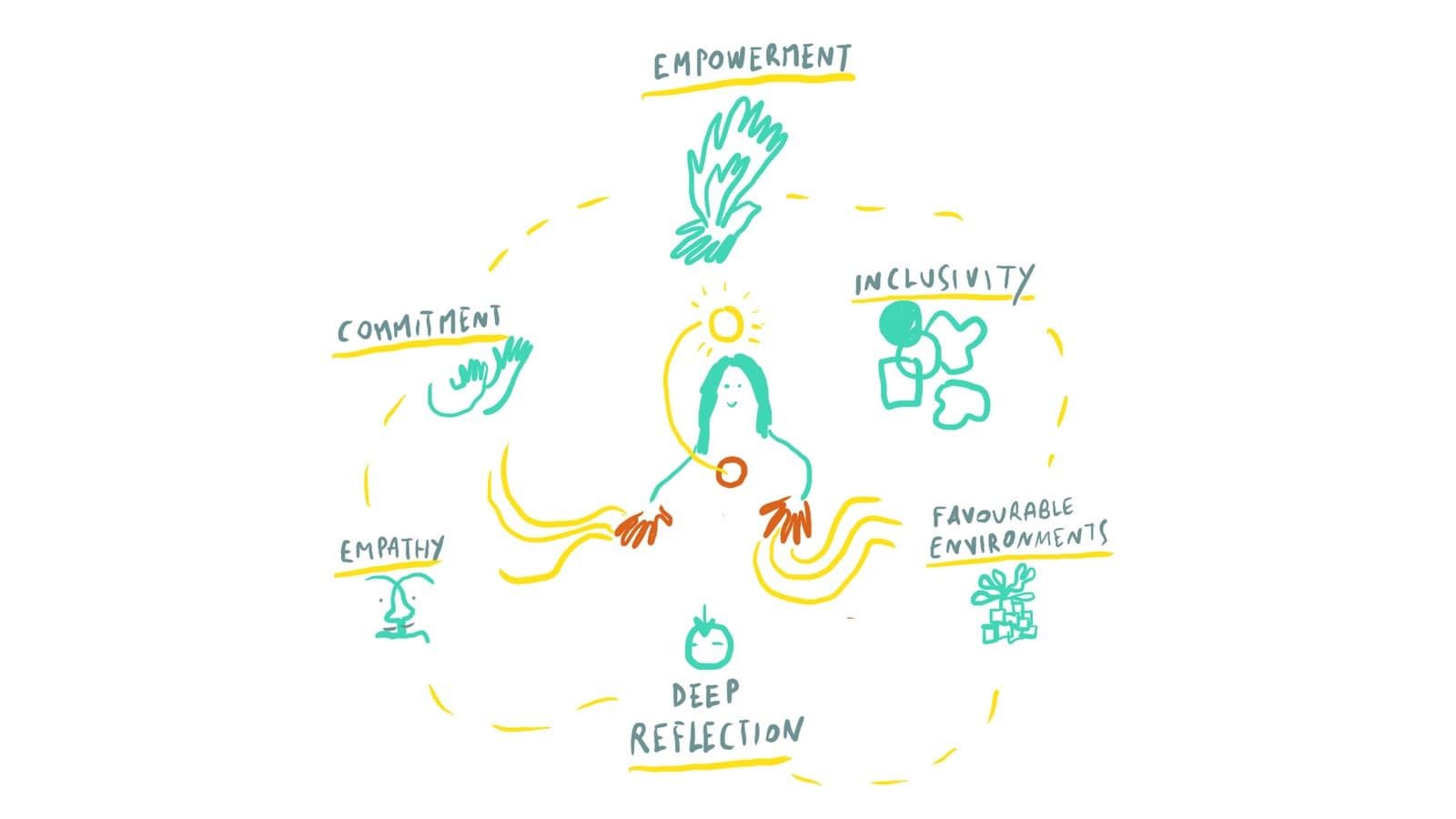
I help individuals, teams and organisations move through transitions and transformations with more awareness and agency. Over the years, working across different countries and sectors, I have come to see leadership not as a fixed set of skills but as something that develops through a constant interplay between a person, the role they occupy, and the organisation they belong to. This is the lens I bring to every coaching conversation, whether I am working with an executive, a team, or a wider organisational system.
In this article, I want to share how I work and what clients can expect when they choose to work with me as their executive or leadership coach.
Looking at the Person, the Role, and the Organisation Together
One of the things I find clients value most is that I never look at a leadership challenge in isolation. When someone comes to me with a question about their leadership, a difficult relationship with a colleague, or a career transition, I invite them to consider three interconnected dimensions: who they are as a person, what their role actually asks of them, and how the wider organisation and its context shape both.
This way of looking at things comes from systems psychodynamic theory, group relations methodologies, and complexity theory, disciplines I have studied and continue to draw on in my practice. They help me and my clients surface hidden factors that are often at play beneath the surface of a leadership challenge, factors that are not always visible from the inside of a situation but that strongly influence how we behave, decide, and relate to others.
Working this way means that coaching becomes a joint exploration rather than a one-directional exchange of advice. Together, we try to build a more in-depth understanding of what is going-on, so that new, more effective behaviours can emerge from genuine insight rather than from a technique or suggestion. Emotions are always valuable data we want to use in this joint exploration.
Creating a Space for Reflection
Executive coaching only works if there is real trust. I offer my clients deep empathy and high levels of confidentiality, because the kind of reflection that leads to change requires a space that feels and is safe. Many of the people I work with are dealing with ambiguity, pressure, or the complexity of organisational life, and they need a place where they can think out loud without worrying about judgment or exposure.
In our sessions, I sometimes use creative practices such as role drawing, which allows clients to explore their role history and biography in a way that goes beyond words alone. This can open up unexpected and useful insights about how someone arrived at their current role, what patterns they are repeating, and what possibilities are available to them that they had not previously considered.
I also draw on a theoretical model called Transforming Experience into Authentic Action in Role (Long, S., 2016), which helps unfold the complexities and ambiguities that come with holding a position of responsibility in an organisation. The aim is always the same: to help clients make sense of their thoughts and emotions as they relate to their role, their leadership, and their place within the larger organisational structure, so they can act with more clarity and authenticity.
Working together: Why Leaders Reach Out to Me
Readers who want more detail about the specific situations that typically bring clients to me can find this on my website, but broadly speaking, these are moments when the usual ways of coping no longer feel sufficient, and a more reflective space is needed to find an effective way forward.
Whether you are facing a career transition, stepping into a new role, working through stress or a loss of confidence, trying to strengthen how you communicate and lead your team, navigating difficult team or board dynamics, or trying to find your footing again after a period of change or simply to understand your role more clearly within your organisation, I would be glad to accompany you in that exploration. I work in French, English and Italian, and I offer sessions online as well as from my base in Brussels.
If this way of working inspires or resonates with you, I invite you to book a free discovery session with me on EraCoach: https://eracoach.com/en/coaches/annalisa-bortoluzzi. It is a simple first step to see whether this kind of reflective, systemic coaching is the right fit for where you are right now.
My background and equity-centred focus
My own experience shapes how I accompany people and organisations through change. Between 1999 and 2012, I worked in several countries of the Global South, and since 2013 I have worked mostly with European and global purpose-driven membership organisations, including associations, alliances, federations and networks, in the Brussels arena and beyond. This combination of experiences, across NGOs, CSOs and businesses, in very different cultural and organisational contexts, has given me a practical understanding of how issues look from varied and diverse perspectives. I try to bring that same openness into every coaching relationship, regardless of sector or geography.
My academic background is similarly varied: I hold a Master's in Cooperation and Development from the University of Pavia and a MSc in Civil Hydraulic Engineering from the University of Padua, alongside my coaching qualifications from the Tavistock Institute of Human Relations in London, where I completed a Certificate in Coaching for Leadership with a focus on psychodynamic approaches, and a Practitioner Certificate in Consulting and Change. This mix of disciplines gives me what I think of as a complex lens, one that helps me accompany people not just as leaders, but as whole individuals embedded in systems that are constantly changing.
As an equity-centred coach, I bring an explicit attention to power, voice, and intersectionality into my coaching work. I am committed to, and actively practice and promote, principles of non-discrimination, diversity, equality, inclusion, and justice. This shows up in how I listen, in the questions I ask, and in my interest in helping clients understand how their leadership intersects with broader structures of power within their organisations and beyond.
I have a strong interest in our interconnected world and in working towards global solidarity. This is not separate from my coaching practice. It informs how I think about leadership itself: not as an individual achievement, but as something that is always exercised in relation to others, to systems, and to the wider world.

Ready to take action?
Find the coach who matches your goal
Hand-picked certified coaches. Free first discovery session, no commitment.